
Table of Contents
Introduction: Empowering Women Through Action
Knowing How to file a Women’s Safety Complaint is a skill every woman should have, yet many hesitate or feel unsure about the process. Have you ever faced harassment, unsafe situations, or unfair treatment but didn’t know where to turn? You’re not alone. The good news is that in 2026, the process is streamlined, digital, and designed to protect your privacy.
Learning How to File a Women’s Safety Complaint can be the turning point in addressing issues of harassment. Knowing How to File a Women’s Safety Complaint empowers women to stand up for their rights.
Furthermore, understanding How to File a Women’s Safety Complaint can enhance community safety.
When discussing How to File a Women’s Safety Complaint, it is essential to understand your rights and the systems in place to protect you.
Filing a complaint is about more than just raising your voice; it is about exercising your legal rights. When you understand How to file a Women’s Safety Complaint, you help create a safer environment for yourself and others.

What is a Formal Complaint?
Moreover, knowing How to File a Women’s Safety Complaint can provide a sense of security and encourage others to take action.
A complaint is a formal report of a problem or unsafe behavior submitted to the correct authority so action can be taken. It can be submitted via a physical letter, email, or specialized apps for women’s safety.
When learning How to file a Women’s Safety Complaint, it is important to distinguish between a general grievance and a legal report. In serious cases, knowing the correct helpline numbers and what to do in a dangerous situation is the first step before filing a formal report.
Common types of complaints include:
Utilizing the resources available and knowing How to File a Women’s Safety Complaint will help protect your rights.
- Educational Institutions: Harassment or unfair behavior by staff or students.
- Workplace: Unsafe environments, discrimination, or sexual harassment.
- Digital Space: Stalking, deepfakes, or online abuse.
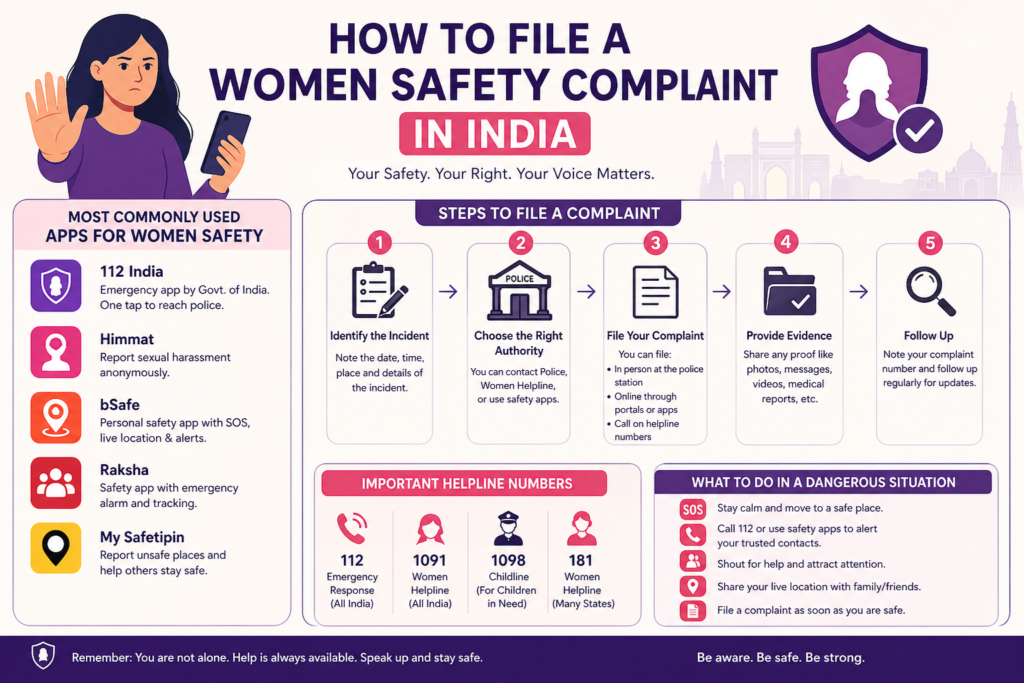
How to File a Complaint Without a Police Station
Understanding How to File a Women’s Safety Complaint is crucial for women in any adverse situation.
Take note that knowing How to File a Women’s Safety Complaint also helps you navigate the legal landscape better.
In 2026, the legal system is more accessible than ever. Under the Bharatiya Nagarik Suraksha Sanhita (BNSS), women are specifically exempted from visiting a police station for initial reports and investigations. You have the legal right to report crimes via electronic communication.
The 4 Pillars of a Strong Complaint
Step 1: Choose the Right Portal
Depending on the incident, use these official government platforms:
- For Cyber Crimes (Stalking, Harassment, AI deepfakes): Visit the National Cyber Crime Reporting Portal at
cybercrime.gov.in. - For Rights Violations & Domestic Violence: Contact the National Commission for Women (NCW) at
ncwapps.nic.in. - For Workplace Harassment: Use the SHe-Box portal at
shebox.wcd.gov.in.
Step 2: Collect Your Evidence
Before submitting, prepare your “Digital Evidence Kit”:
- Screenshots: Clear captures of messages, comments, or posts.
- Media Files: Any audio recordings or videos of the incident.
- Identification: A soft copy of your ID proof (such as a Driver’s License, PAN, or [Aadhaar Redacted]) to verify your identity.
Step 3: The Filing Process (The 4 Pillars)
To ensure your report is effective, follow these four pillars:
- Incident Details: Be exact with dates, times, and locations.
- Narrative: Describe what happened in simple, honest language.
- Suspect Info: Provide names, phone numbers, or social media handles if known.
- Action Sought: Clearly state if you want an FIR registered or content removed.
Step 4: Tracking & Your 2026 Rights
- Acknowledgment: You will receive a Complaint Number and Login ID. Save these to track progress online.
- Home Investigation: In 2026, you can request that police record your statement at your residence rather than the station.
- Audio-Video Recording: Statements for sensitive cases are now recorded via video to ensure transparency.
Sample Women’s Safety Complaint Letter Format
If you prefer to submit a written letter to an authority or local cell, use this beginner-friendly format:
To, [Authority Name, e.g., The Internal Committee Chairperson or Police Superintendent]
Subject: Formal complaint regarding [Type of Harassment/Issue]
Respected Sir/Madam,
Remember, How to File a Women’s Safety Complaint is not just a process but an important step toward justice.
I am writing to formally submit a complaint regarding [describe the problem]. On [Date] at [Location/Platform], the following incident occurred: [Briefly explain the details].
I have attached [mention evidence, e.g., screenshots/recordings] to support this claim. I request you to kindly take necessary legal action to ensure my safety and privacy.
Thank you.
Yours sincerely, [Your Name]
[Your Contact Details]
Top 4 Platforms to File Your Complaint (Privacy Focus)
In 2026, “Privacy” is not just a preference; it is a legal right. These four platforms are designed to protect your identity while ensuring the offender is held accountable. Here is why these are the gold standard for women’s safety:
1. For AI Crimes (Deepfakes): The National Cyber Crime Portal
- Why Use This: In the age of AI, a single “morphed” image can go viral in minutes. This portal is the only one with the legal authority to trigger the “2-Hour Takedown Rule.”
- The Power Factor: Under the 2026 IT Amendments, once you file a complaint here, the government issues a “Digital Kill Switch” order. Social media giants must remove the AI-generated content globally within 2 hours or face massive fines. It stops the spread before the damage is permanent.
- Website:
cybercrime.gov.in
2. For Data Leaks (Doxing): StopNCII.org
Ultimately, How to File a Women’s Safety Complaint is a vital part of ensuring your protection.
For those interested, learning How to File a Women’s Safety Complaint will significantly benefit your case.
- Why Use This: Most women fear that even if a photo is deleted, it will be re-uploaded. StopNCII solves this using “Digital Fingerprinting” (Hashing).
- The Power Factor: You do not upload your photo to their server. Instead, the tool creates a digital code (hash) of the image. This code is shared with partners like Instagram, Facebook, and X (Twitter). If anyone tries to upload that specific file again, the system blocks it automatically. It provides a “permanent shield” without ever compromising your actual image.
- Website:
stopncii.org
3. For General Rights & Domestic Issues: The NCW Online Portal
In conclusion, the knowledge of How to File a Women’s Safety Complaint is your first step towards safety.
- Why Use This: Traditional police reports can sometimes be viewed by unauthorized personnel or leaked to local media. The National Commission for Women (NCW) provides a high-security alternative.
- The Power Factor: The NCW acts as a “Constitutional Watchdog.” When you file here, your case is handled by specialized cells in New Delhi. It creates a Confidential Digital Trail that even local influential people cannot tamper with. It is your best option if you feel the local authorities are not being fair.
- Website:
ncwapps.nic.in
4. For Workplace Harassment: The SHe-Box Portal
- Why Use This: Reporting to your own company’s HR can be terrifying. SHe-Box (Sexual Harassment electronic Box) ensures that your company cannot “sweep the issue under the carpet.”
- The Power Factor: Once you submit a complaint, it is visible to both your employer’s Internal Committee and the Ministry of Women and Child Development. This dual-monitoring forces the company to follow the POSH Act strictly. If they don’t resolve your case in time, the government can take direct action against the organization.
- Website : shebox.wcd.gov.in
Conclusion: From Fear to Action
Understanding How to File a Women’s Safety Complaint is a powerful tool for justice. Whether you are using apps for women’s safety or official government portals, taking the first step is what matters most.
“Raising your voice is your right. Filing a complaint properly ensures that your voice is heard and justice is served.